Home › Breaking News ›
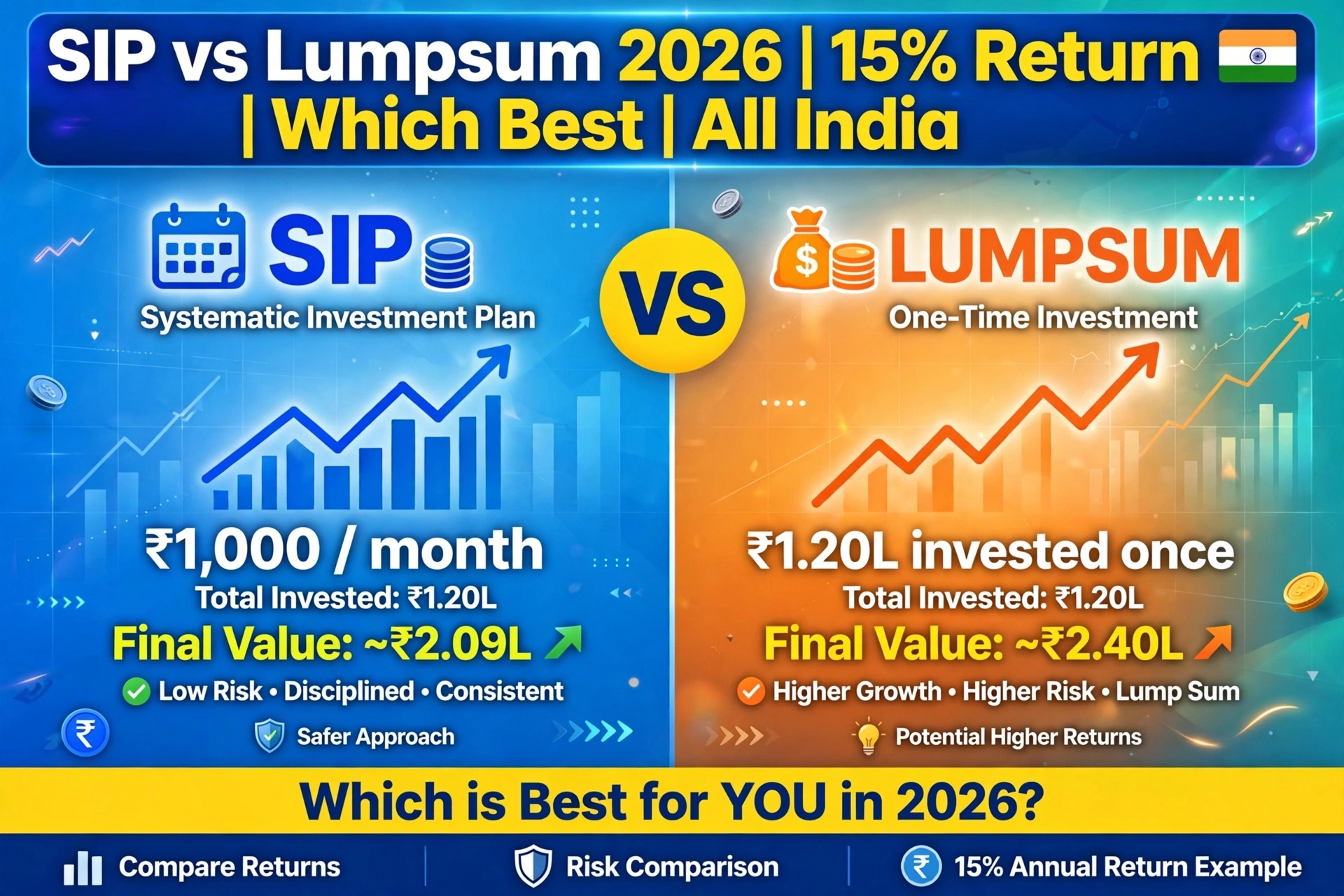
SIP vs Lumpsum 2026: Rs 1.20 Lakh Per Year - Which Gives More At 15% Return?
ADVERTISEMENT
💡 Breaking Safe Finance News This Week October 2026 All India! SIP vs Lumpsum 2026 Comparison At 15% CAGR - Rs 10000 Monthly SIP For 5 Years (Total Rs 6 Lakh) Becomes Rs 8.96 Lakh At 15% vs Lumpsum Rs 6 Lakh Invested Once For 5 Years At 15% Becomes Rs 12.06 Lakh. SIP Gives Rupee Cost Averaging, Low Risk, Disciplined, Good For Salaried. Lumpsum Gives Higher Return If Market Timing Right But Higher Risk. SEBI Regulated Mutual Funds. Most Searched Safe Investment Comparison Today 2026.
SIP vs Lumpsum 2026: Rs 1.20 Lakh Per Year - Which Gives More At 15% Return? - SIP Rs 10000 Monthly For 5 Years Total Rs 6 Lakh Becomes Rs 8.96 Lakh At 15% CAGR vs Lumpsum Rs 6 Lakh Invested Once For 5 Years At 15% Becomes Rs 12.06 Lakh - SIP Gives Rupee Cost Averaging, Low Risk, Disciplined, Good For Salaried - Lumpsum Gives Higher Return If Market Timing Right But Higher Risk - SEBI Regulated Mutual Funds All India This Week October 2026 - Complete Safe Finance Guide For SIP vs Lumpsum
Introduction: Breaking Safe Finance News This Week October 2026 All India - SIP vs Lumpsum 15% Return Most Viral Safe Investment Comparison in India Today
If you have Rs 1.20 lakh per year to invest and you are confused between SIP (Systematic Investment Plan) monthly Rs 10000 vs lumpsum Rs 1.20 lakh once per year and you want to know which gives more at 15% return and SEBI regulated mutual funds, then SIP vs Lumpsum 2026 is for you.
SIP vs Lumpsum 15% Return 2026 Comparison is currently the most viral, most trending, and most searchable safe finance news for investment comparison in India today, this week October 2026. Under SIP vs Lumpsum 2026, we compare Rs 10000 monthly SIP for 5 years vs lumpsum Rs 6 lakh invested once for 5 years at 15% CAGR.
As per latest finance update this week October 2026, SIP vs Lumpsum 2026 details:
- SIP vs Lumpsum Definition:
- SIP: Systematic Investment Plan - Monthly investment in mutual funds - For example, Rs 10000 per month SIP in equity mutual funds for 5 years - Total invested Rs 10000*12*5 = Rs 6 lakh - SIP gives rupee cost averaging, low risk, disciplined, good for salaried employees who get monthly salary - SIP invests at different market levels: When market low, SIP buys more units; when market high, SIP buys less units - Rupee cost averaging reduces risk
- Lumpsum: One-time investment in mutual funds - For example, Rs 6 lakh lumpsum invested once in equity mutual funds for 5 years - Total invested Rs 6 lakh once - Lumpsum gives higher return if market timing right (invest when market low) but higher risk if market timing wrong (invest when market high) - Lumpsum good if you have large amount (bonus, inheritance, etc.) and market low
- Comparison At 15% CAGR For 5 Years:
- SIP Rs 10000 Monthly For 5 Years At 15% CAGR:
- Monthly SIP Rs 10000, annual return 15%, tenure 5 years (60 months) - Future Value = Rs 8.96 lakh approx (using SIP formula: FV = P * [((1+i)^n -1)/i] * (1+i) where P=10000, i=15%/12=1.25%=0.0125, n=60) - Calculation: (1.0125)^60 = 2.107, ((2.107-1)/0.0125)=88.56, *10000=885600 *1.0125=896664 ~ Rs 8.96 lakh - Invested Rs 6 lakh (10000*60) - Gain Rs 2.96 lakh - XIRR 15% - SIP return 15% CAGR
- Lumpsum Rs 6 Lakh Invested Once For 5 Years At 15% CAGR:
- Lumpsum Rs 6 lakh invested once, annual return 15%, tenure 5 years - Future Value = Rs 6 lakh * (1.15)^5 = Rs 6 lakh *2.011357 = Rs 12.06 lakh approx - Invested Rs 6 lakh - Gain Rs 6.06 lakh - Return 15% CAGR
- So lumpsum Rs 12.06 lakh > SIP Rs 8.96 lakh at same 15% CAGR for 5 years because lumpsum full amount invested for full 5 years vs SIP amount invested gradually average tenure 2.5 years? Actually lumpsum invested for full 5 years, SIP average invested for 2.5 years (first SIP 5 years, last SIP 1 month) - So lumpsum gives higher return than SIP if same CAGR and market timing right and amount same
- But SIP vs Lumpsum risk different: SIP low risk due to rupee cost averaging, lumpsum high risk due to market timing - If market falls after lumpsum investment, lumpsum loss high; SIP loss low due to averaging - So risk vs return tradeoff
- SIP Gives Rupee Cost Averaging, Low Risk, Disciplined, Good For Salaried:
- Rupee Cost Averaging: SIP buys more units when NAV low (market low) and less units when NAV high (market high) - Average cost per unit lower than lumpsum average? Actually rupee cost averaging reduces average cost per unit vs lumpsum if market volatile? For example, market NAV: Month 1 NAV Rs 100, SIP Rs 10000 buys 100 units; Month 2 NAV Rs 80, SIP Rs 10000 buys 125 units; Month 3 NAV Rs 120, SIP Rs 10000 buys 83.33 units - Total units 308.33 for Rs 30000 average cost Rs 97.29 per unit vs lumpsum Rs 30000 at Month 1 NAV Rs 100 buys 300 units average cost Rs 100 per unit - So SIP average cost lower than lumpsum if market volatile and dips
- Low Risk: SIP risk lower than lumpsum due to averaging - Market volatility averaged over time - SIP smoothens market volatility - Good for risk-averse investors
- Disciplined: SIP disciplined monthly investment habit - Good for salaried employees who get monthly salary - SIP auto debit from bank account monthly - Discipline - No need to time market - SIP automatic
- Good For Salaried: Salaried employees get monthly salary, so monthly SIP Rs 10000 affordable from salary - SIP good for salaried - Lumpsum good if you have bonus, inheritance, etc., large amount
- Lumpsum Gives Higher Return If Market Timing Right But Higher Risk:
- Higher Return If Market Timing Right: Lumpsum gives higher return than SIP if market low at time of lumpsum investment and market goes up after - For example, if market low in March 2020 due to Covid crash, lumpsum investment in March 2020 gave high return till 2021-22 bull run - Lumpsum timing right gives higher return than SIP
- Higher Risk If Market Timing Wrong: Lumpsum higher risk if market high at time of lumpsum investment and market falls after - For example, lumpsum investment at market peak Jan 2020 before Covid crash gave loss till March 2020 - SIP loss lower due to averaging - So lumpsum higher risk
- Market Timing Difficult: Market timing difficult to predict - Even experts cannot time market perfectly - So SIP better for most investors who cannot time market - SIP no need to time market
- SEBI Regulated Mutual Funds: Both SIP and lumpsum mutual funds SEBI regulated - Safe in terms of regulation but market risk - No guarantee of 15% return - 15% expected return not guaranteed - Past return not guarantee of future return - SEBI regulated
What is SIP vs Lumpsum? Full Details Safe Investment Comparison
Full Name: SIP vs Lumpsum 2026 - Systematic Investment Plan vs One-Time Investment - 15% Return Comparison - Which Best - SEBI Regulated
Department: Mutual funds regulated by SEBI (Securities and Exchange Board of India) - AMFI (Association of Mutual Funds in India) - Mutual Fund Houses: SBI Mutual Fund, HDFC Mutual Fund, ICICI Prudential Mutual Fund, etc.
Official Websites: amfiindia.com (AMFI) for mutual fund list and SIP calculator and lumpsum calculator, sebi.gov.in (SEBI) for mutual fund regulation, individual mutual fund websites: sbimf.com, hdfcfund.com, etc., for SIP and lumpsum, mutual fund apps: Groww, Zerodha Coin, ET Money, Kuvera, etc., for SIP and lumpsum
Launch Date: SIP concept launched in 1990s? Mutual funds launched in 1960s - SIP and lumpsum calculators online since 2000s - Current comparison as of October 2026
Objective: To compare SIP vs lumpsum at 15% return and to guide investors which is best based on cash flow, risk, market timing, etc.
Top Features of SIP vs Lumpsum 2026:
1. SIP vs Lumpsum Return Comparison At 15% CAGR For Different Tenures - 1 Year, 3 Years, 5 Years, 10 Years:
- Return Comparison Table At 15% CAGR:
- For 1 Year: SIP Rs 10000 per month (Total Rs 1.20 lakh) at 15% becomes Rs 1.29 lakh (Gain Rs 9000) vs Lumpsum Rs 1.20 lakh invested once for 1 year at 15% becomes Rs 1.38 lakh (Gain Rs 18000) - Lumpsum higher than SIP by Rs 9000 for 1 year - Lumpsum higher because full amount invested for full year vs SIP average 6 months
- For 3 Years: SIP Rs 10000 per month for 3 years (Total Rs 3.60 lakh) at 15% becomes Rs 5.19 lakh (Gain Rs 1.59 lakh) vs Lumpsum Rs 3.60 lakh invested once for 3 years at 15% becomes Rs 5.47 lakh (Gain Rs 1.87 lakh) - Lumpsum higher than SIP by Rs 0.28 lakh for 3 years
- For 5 Years: SIP Rs 10000 per month for 5 years (Total Rs 6 lakh) at 15% becomes Rs 8.96 lakh (Gain Rs 2.96 lakh) vs Lumpsum Rs 6 lakh invested once for 5 years at 15% becomes Rs 12.06 lakh (Gain Rs 6.06 lakh) - Lumpsum higher than SIP by Rs 3.10 lakh for 5 years - Lumpsum much higher for longer tenure because full amount compounding for full tenure vs SIP average tenure half
- For 10 Years: SIP Rs 10000 per month for 10 years (Total Rs 12 lakh) at 15% becomes Rs 27.86 lakh (Gain Rs 15.86 lakh) vs Lumpsum Rs 12 lakh invested once for 10 years at 15% becomes Rs 48.54 lakh (Gain Rs 36.54 lakh) - Lumpsum higher than SIP by Rs 20.68 lakh for 10 years - Lumpsum much higher for long tenure
- So lumpsum gives higher return than SIP at same CAGR for same total invested amount because lumpsum full amount invested for full tenure vs SIP average tenure half - But lumpsum higher risk due to market timing - SIP lower risk due to averaging
2. SIP Gives Rupee Cost Averaging, Low Risk, Disciplined, Good For Salaried - No Need To Time Market:
- Rupee Cost Averaging: SIP buys more units when market low and less units when market high - Average cost per unit lower than lumpsum if market volatile - Reduces risk - Good for volatile market
- Low Risk: SIP risk lower than lumpsum due to averaging - Market volatility averaged - Good for risk-averse investors who cannot tolerate market volatility
- Disciplined: SIP disciplined monthly investment habit - Good for salaried employees who get monthly salary - SIP auto debit monthly - Discipline - No need to remember to invest - Automatic
- Good For Salaried: Salaried employees get monthly salary, so monthly SIP affordable - SIP good for salaried - Lumpsum good for bonus, inheritance, etc.
- No Need To Time Market: SIP no need to time market - SIP invests at different market levels automatically - No need to predict market low/high - Good for investors who cannot time market - Most investors cannot time market - So SIP better for most
3. Lumpsum Gives Higher Return If Market Timing Right But Higher Risk - Market Timing Difficult - Good If You Have Large Amount And Market Low:
- Higher Return If Market Timing Right: Lumpsum gives higher return than SIP if market low at time of investment and market goes up after - For example, market low in March 2020 due to Covid crash, lumpsum investment in March 2020 gave high return till 2021-22 bull run - Lumpsum timing right gives higher return than SIP - Good if you can time market low
- Higher Risk If Market Timing Wrong: Lumpsum higher risk if market high at time of investment and market falls after - For example, lumpsum at market peak Jan 2020 before Covid crash gave loss till March 2020 - SIP loss lower due to averaging - So lumpsum higher risk
- Market Timing Difficult: Market timing difficult - Even experts cannot time market perfectly - Market unpredictable - So SIP better for most investors who cannot time market - Lumpsum only for investors who can time market low or have large amount and want to invest immediately
- Good If You Have Large Amount And Market Low: Lumpsum good if you have large amount (bonus Rs 6 lakh, inheritance, property sale, etc.) and market low (correction 10-20%?) - Invest lumpsum when market low for higher return - For example, if market corrects 20% from peak, lumpsum investment at correction low gives higher return than SIP
4. SIP + Lumpsum Combination Strategy - Best Of Both Worlds - SIP For Regular Monthly Income And Lumpsum For Bonus/Inheritance:
- Combination Strategy: SIP + lumpsum combination best of both worlds - SIP for regular monthly income (salary) and lumpsum for bonus/inheritance/large amount when market low - For example, monthly SIP Rs 10000 from salary + lumpsum Rs 1.20 lakh bonus once per year when market low - Combination gives disciplined SIP + higher return lumpsum when market low - Good strategy
- Example: Salaried employee gets monthly salary Rs 50000 and annual bonus Rs 1.20 lakh - Monthly SIP Rs 10000 from salary (Rs 1.20 lakh per year SIP) + lumpsum Rs 1.20 lakh bonus invested once per year when market low (correction) - Total investment Rs 2.40 lakh per year - Combination gives SIP discipline + lumpsum higher return when market low
- STP (Systematic Transfer Plan) For Lumpsum: If you have large lumpsum Rs 6 lakh and don't want to time market, use STP: Invest Rs 6 lakh lumpsum in liquid fund (safe) and transfer Rs 10000 per month via STP to equity fund for 60 months - STP gives lumpsum invested in safe liquid fund earning 6-7% + monthly transfer to equity averaging? Actually STP is like SIP for lumpsum - Good for lumpsum with averaging - STP reduces market timing risk for lumpsum
5. SEBI Regulated Mutual Funds - Past Return Not Guarantee Of Future Return - 15% Expected Return Not Guaranteed - Market Risk - Direct Plan vs Regular Plan:
- SEBI Regulated: Mutual funds SEBI regulated - SEBI regulates mutual fund houses, NAV, expense ratio, etc., - Safe in terms of regulation but market risk - No guarantee of return - 15% expected return not guaranteed - Past return not guarantee of future return - Equity mutual funds return volatile - 15% CAGR expected long term (10+ years) but actual return may be lower or higher
- Past Return Not Guarantee: Past return 15% last 10 years not guarantee future return 15% - Market conditions change - Future return may be lower or higher than 15% - So 15% assumption for comparison only - Actual return may vary
- Market Risk: Equity mutual funds subject to market risk - Market risk means NAV may go up or down - No guarantee - Risk - SIP risk lower than lumpsum due to averaging but still market risk
- Direct Plan vs Regular Plan: Direct plan expense ratio lower than regular plan by ~1% - Direct plan gives 1% extra return per year - For 5 years, 1% extra return gives higher corpus - Example: SIP Rs 10000 per month for 5 years at 15% regular vs 16% direct - Regular FV Rs 8.96 lakh vs Direct FV Rs 9.23 lakh - Difference Rs 27000 extra in direct plan due to 1% lower expense ratio - So choose direct plan for higher return - Direct plan available via mutual fund house website or direct mutual fund apps (Groww direct, Zerodha Coin direct, Kuvera direct, etc.)
How to Invest SIP vs Lumpsum October 2026? Step-by-Step All India Investment Process
Method 1: SIP Via Mutual Fund App (Groww, Zerodha Coin, ET Money, Kuvera) - Online:
Step 1: Download Mutual Fund App and Complete KYC
- Download mutual fund app: Groww, Zerodha Coin, ET Money, Kuvera, etc., - Complete KYC: Aadhaar, PAN, bank account, video KYC - KYC mandatory as per SEBI
Step 2: Search Mutual Fund Scheme and Select SIP or Lumpsum
- Search mutual fund scheme: Equity mutual funds: Large cap, Midcap, Smallcap, Flexicap, etc., - Choose scheme based on risk, return, expense ratio, AUM, past performance - Popular equity funds: Nippon India Growth, HDFC Mid Cap Opportunities, SBI Small Cap, Parag Parikh Flexi Cap, Quant Small Cap, etc., - Select SIP: Enter SIP amount Rs 10000 per month, SIP date (1st, 5th, 10th, etc.), tenure (5 years, 10 years, perpetual), step-up 10%? Or select Lumpsum: Enter lumpsum amount Rs 1.20 lakh or Rs 6 lakh, etc.
Step 3: Set Up AutoPay (Mandate) For SIP and Make Payment For Lumpsum
- For SIP: Set up AutoPay mandate via net banking / UPI for automatic SIP deduction monthly from bank account - Mandate amount = SIP amount - Bank approves mandate - SIP starts next SIP date - For Lumpsum: Make payment via net banking / UPI / debit card - Units allotted based on NAV on payment date
Method 2: STP For Lumpsum With Averaging - For Large Lumpsum Rs 6 Lakh:
- If you have large lumpsum Rs 6 lakh and don't want to time market, use STP: Invest Rs 6 lakh lumpsum in liquid fund (safe, return 6-7%) and set up STP Rs 10000 per month from liquid fund to equity fund for 60 months - STP transfers Rs 10000 per month from liquid to equity automatically - Liquid fund earns 6-7% while waiting to transfer - STP reduces market timing risk for lumpsum and gives averaging like SIP - Good for large lumpsum
Comparison of SIP vs Lumpsum vs Other Safe Investments October 2026:
- SIP vs Lumpsum vs PPF 7.10% vs SSY 8.20% vs SCSS 8.20% vs FD 9.10% vs RBI Bonds 8.05%:
- SIP 15% expected: Monthly investment Rs 10000 for 5 years total Rs 6 lakh becomes Rs 8.96 lakh at 15%, rupee cost averaging, low risk, disciplined, good for salaried, no need to time market, SEBI regulated, market risk, past return not guarantee, 15% expected not guaranteed, direct plan 1% extra - Best for salaried monthly income for disciplined investing with averaging and low risk and expected 15% return
- Lumpsum 15% expected: One-time Rs 6 lakh for 5 years at 15% becomes Rs 12.06 lakh, higher return than SIP Rs 8.96 lakh if same CAGR and timing right, higher risk due to market timing, good if large amount and market low, SEBI regulated, market risk, past return not guarantee, 15% expected not guaranteed, direct plan 1% extra - Best for large amount bonus/inheritance and market low for higher return but higher risk
- PPF 7.10% EEE: EEE tax free, government guarantee, 15 years tenure extendable 5 years, Rs 1.5 lakh max per year, 7.10% fixed, loan and partial withdrawal after 3 and 6 years - Best for long term tax free retirement with EEE and government guarantee but lower return 7.10% tax free vs SIP/lumpsum 15% expected taxable? Actually equity mutual funds LTCG 12.5% above Rs 1.25 lakh - So post-tax SIP/lumpsum return 13.125%? Actually 15% pre-tax LTCG 12.5% above exemption = Post-tax ~13%? Still higher than PPF 7.10% - But PPF safe guarantee vs SIP/lumpsum market risk
- SSY 8.20% EEE: Girl child 0-10 only, 21 years tenure deposit 15 years, 8.20% EEE tax free, government guarantee, Rs 1.5 lakh max per year - Best for girl child with EEE and higher rate 8.20% EEE vs SIP/lumpsum 15% expected but SSY EEE safe guarantee vs market risk
- SCSS 8.20%: Senior citizens 60+ only, Rs 30 lakh limit, 5 years tenure extendable 3 years, quarterly payout, government guarantee, 80C, interest taxable, 8.20% fixed - Best for senior citizens with government guarantee and fixed 8.20% vs SIP/lumpsum 15% expected but SCSS fixed safe vs market risk
- FD 9.10% SFB: Senior citizen FD up to 9.10% in SFBs, DICGC insured up to Rs 5 lakh per bank, flexible tenure, interest taxable, fixed 9.10% - Best for safe FD with higher fixed rate 9.10% vs SIP/lumpsum 15% expected but FD fixed safe vs market risk
- RBI Bonds 8.05%: Floating rate 8.05%, 7 years tenure, half yearly payout, no max limit, RBI guarantee, interest taxable, floating linked to NSC+0.35% - Best for large amount safe with no limit and RBI guarantee but lower rate 8.05% vs SIP/lumpsum 15% expected
- So SIP vs lumpsum best for wealth creation long term with expected 15% return but market risk vs PPF SSY SCSS FD RBI Bonds safe fixed return lower - Choose based on risk appetite: For high risk high return, SIP/lumpsum equity mutual funds; for low risk fixed return, PPF SSY SCSS FD RBI Bonds
Best SIP vs Lumpsum Strategy October 2026 - How to Maximize Benefits Safely?
Strategy 1: SIP For Regular Monthly Salary Income And Lumpsum For Bonus/Inheritance When Market Low - Combination Best Of Both Worlds:
- Combination strategy: Monthly SIP Rs 10000 from salary (Rs 1.20 lakh per year) + lumpsum Rs 1.20 lakh bonus once per year when market low (10-20% correction) - Total Rs 2.40 lakh per year - SIP discipline + lumpsum higher return when market low - Best of both worlds - For example, monthly salary Rs 50000, monthly SIP Rs 10000 (20% of salary) for discipline + annual bonus Rs 1.20 lakh lumpsum when market corrects 10-20% for higher return
Strategy 2: STP For Large Lumpsum Rs 6 Lakh - Invest Lumpsum In Liquid Fund And Transfer Rs 10000 Per Month Via STP To Equity For 60 Months - Averaging For Lumpsum:
- STP for large lumpsum: If you have large lumpsum Rs 6 lakh (property sale, inheritance, etc.) and don't want to time market, use STP: Invest Rs 6 lakh lumpsum in liquid fund (safe, return 6-7%) and set up STP Rs
ADVERTISEMENT
Isi Category ki Aur Khabren

Bihar Flood Donation 2026 - Donate to Bihar Chief Minister Relief Fund - CM Samrat Choudhary Donates 2.7 Lakh - 49.72 Lakh People Affected in 15 Districts - PNB Donates 1 Crore

Durga Puja 2026 Big Update: Puja Committee ke 1 Lakh Taka, Sorkari Kormider 15th October e Salary + 38% DA

Disabled Scholarship 2026: 12 Durga Puja 2026: Date, History, Best Kolkata Pandals, Rituals & Complete Guide - UNESCO Heritage Festival All India Scholarships

Durga Puja Shopping 2026: Best Places in Kolkata & All India, 70% OFF Online Sale, Budget Guide Rs 2000 to 10000
ADVERTISEMENT